
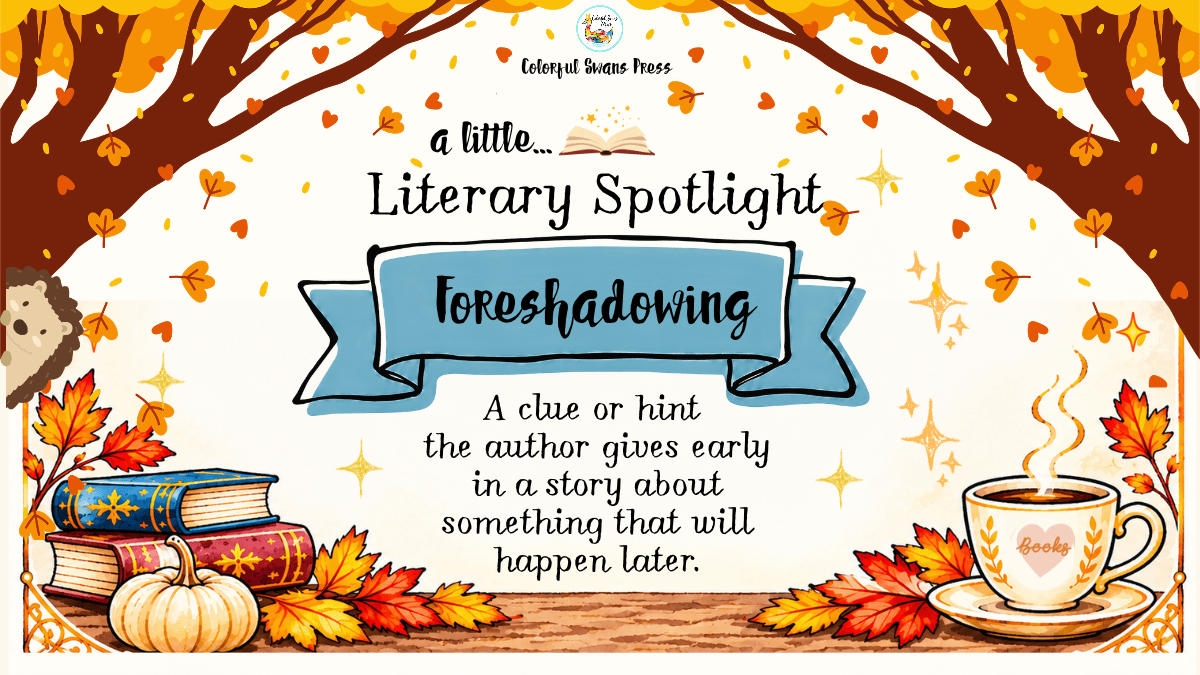
Happy Thursday, everyone! Let’s talk about books—and one of my favorite literary terms: foreshadowing.
I thought it might be fun to occasionally explore the things that make stories interesting. Nothing too serious—just a quick look at a literary term, what it means, and a few examples. (Honestly, do we ever really need a reason to talk about books?) 🙂
So let’s get to it.
I figured we’d start with a very useful term: foreshadowing.
Have you ever gotten to the end of a book, discovered some big plot twist, and realized the author had been dropping hints about it the entire time?
I love when that happens. Although I’m usually a little annoyed with myself for not noticing sooner.
That’s foreshadowing. It’s when an author gives us little clues about something that’s going to happen later in the story.
Let’s Imagine an Autumn Mystery
The story opens:
It’s a chilly October afternoon, and a young woman has just inherited her grandmother’s old cottage.
The garden is completely overgrown, the windows rattle whenever the wind blows, and there’s a black cat sitting on the porch who doesn’t seem particularly happy to see her.
So far, nothing too unusual.
But when she walks into the kitchen, she finds a handwritten note sitting on the table.
Whatever you do, don’t open the little blue door after sunset.
Now, I don’t know about you, but I’d immediately want to know what’s behind that door.
And why can’t she open it after sunset? What happens if she does? Also, where exactly is this door?
We’ve only just arrived at the cottage, and already there’s something to worry about.
That’s foreshadowing at work.
We don’t know what’s going to happen yet, but the author has given us a reason to be suspicious of that little blue door.
Personally, I’d probably leave it alone. At least until morning.
What Is Foreshadowing, Anyway?
Simply put, foreshadowing is when an author hints at something that’s going to happen later in the story.
Sometimes those hints are pretty obvious. Other times they’re tucked into ordinary conversations, descriptions, or seemingly unimportant details.
Maybe a character mentions that they’re terrified of the ocean, and later they’re forced to cross it.
Or perhaps someone finds an old necklace that doesn’t seem particularly special until much later, when it turns out to be connected to a family secret.
The trick is giving readers just enough information to make them curious without revealing everything.
And not every strange detail has to mean something, either.
Why I Love Foreshadowing
I think my favorite thing about foreshadowing is how much fun it makes rereading a book.
The first time through, you’re caught up in the story. You’re wondering what’s going to happen, worrying about the characters, and probably making a few predictions that turn out to be completely wrong.
But the second time?
You know what’s coming.
Suddenly, a conversation that seemed perfectly ordinary has a whole new meaning. That odd little detail from chapter three wasn’t so random after all.
I love discovering those connections.
And as a writer, I find it just as interesting to think about how those clues were placed there in the first place. You want the reader to notice enough to be curious, but not so much that they figure everything out before the story has a chance to unfold.
It’s a tricky balance, and when an author gets it right, it’s wonderful.
Keep an Eye Out for Those Little Clues
The next time you’re reading, see if you notice anything that feels a little unusual.
Maybe it’s a peculiar warning, an object that keeps turning up, or a character who seems determined to avoid a particular subject.
It could turn out to be important.
Or it could be absolutely nothing.
That’s half the fun of reading, isn’t it?
And if you ever inherit an old cottage with a mysterious little blue door, perhaps consider reading the note before doing anything adventurous.
Just a thought.
Happy reading!
–Colorful Swans Press 🦢

