Alice in Wonderland, written by Lewis Carroll (the pen name of Charles Lutwidge Dodgson), is a timeless classic that has captivated readers of all ages for generations (myself included!) I’ve read this book dozens of times, and love seeing adaptations and stories inspired by Wonderland. Since today is world happiness day, I thought that some facts about this classic book filled with fanciful characters and silly situations would be a welcome break from reality 😄 So here we go!
- Origin of the Story: The tale of Alice in Wonderland originated during a boat trip on the River Thames in Oxford, England. On July 4, 1862, Lewis Carroll took a boat ride with the Liddell family, during which he entertained the three young Liddell sisters—Lorina, Alice, and Edith—with a story about a little girl named Alice who fell into a fantastical world. Alice Liddell was so enthralled by the story that she begged Carroll to write it down, thus sparking the creation of the iconic tale.
- Mathematical Connections: Lewis Carroll, in his professional life, was a mathematician at Oxford University. His love for mathematics is evident in Alice’s adventures. Throughout the story, there are numerous references to mathematical concepts, logic puzzles, and wordplay. For example, the Mad Hatter’s tea party is said to be an allegory for a mathematical concept called “infinite series,” where time loops endlessly, just like the never-ending tea party.
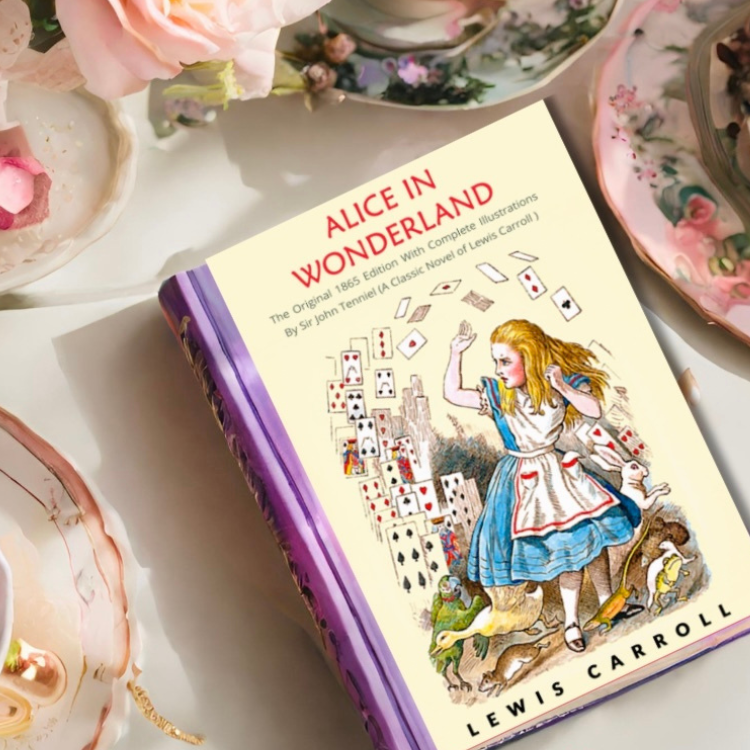
- The Tenniel Illustrations: The original illustrations for Alice in Wonderland were created by Sir John Tenniel, a renowned Victorian artist and political cartoonist. Tenniel’s whimsical and detailed drawings perfectly complement Carroll’s imaginative narrative, helping to bring the fantastical world of Wonderland to life. His illustrations are so iconic that they have become synonymous with the story itself.
- Cultural Impact: Since its publication in 1865, Alice in Wonderland has left an indelible mark on popular culture. It has been adapted into numerous stage productions, films, television shows, and even video games. The story’s characters and imagery have inspired artists, musicians, fashion designers, and filmmakers for over a century, making it one of the most enduring and influential works of literature.
- Translation Extravaganza: Alice in Wonderland has been translated into over 174 languages, making it one of the most translated books in the world. From Afrikaans to Zulu, the story of Alice’s adventures has been enjoyed by people of diverse cultures and backgrounds, showcasing its universal appeal and enduring popularity.
- Controversies and Interpretations: Over the years, scholars and readers have offered various interpretations of Alice in Wonderland, ranging from psychoanalytical readings to political allegories. Some critics have suggested that the story is a satire of Victorian society, with its rigid social norms and absurdities. Others have analyzed it through the lens of existentialism or feminist theory. Regardless of the interpretation, Alice in Wonderland continues to spark lively debates and discussions among literary enthusiasts.
- Carroll’s Pseudonym: Lewis Carroll was actually a pseudonym used by Charles Lutwidge Dodgson. The origins of the name remain somewhat mysterious, with Dodgson reportedly deriving “Lewis Carroll” from the anglicized form of his real name and a Latinized version of “Charles Lutwidge.” The use of a pseudonym was not uncommon among Victorian authors, but it adds an air of intrigue to the authorship of Alice in Wonderland.
- The Queen’s Croquet Ground: One of the most memorable scenes in Alice in Wonderland takes place on the Queen of Hearts’ croquet ground, where the mallets are flamingos and the balls are hedgehogs. This whimsical game of croquet is often interpreted as a satirical commentary on the absurdity of authority and the arbitrary nature of rules.
- Adaptations and Spin-offs: Beyond traditional adaptations, Alice in Wonderland has inspired countless spin-offs, retellings, and reinterpretations across various media. From Tim Burton’s dark and visually stunning film adaptations to modern retellings like “Alice’s Adventures in Wonderland” by Marissa Meyer, the story continues to evolve and resonate with audiences in new and unexpected ways.
- Enduring Legacy: More than 150 years after its initial publication, Alice in Wonderland remains as beloved and relevant as ever. Its themes of curiosity, imagination, and the search for identity continue to resonate with readers of all ages, ensuring that Alice’s adventures will endure for generations to come.
In conclusion, Alice in Wonderland is not just a children’s story—it’s a rich tapestry of imagination, wit, and insight that continues to captivate and inspire audiences around the world. Whether you’re a first-time reader or a lifelong fan, there’s always something new to discover in the enchanting world of Wonderland. So, why not take a trip down the rabbit hole and experience the magic for yourself? As Lewis Carroll himself once said, “Imagination is the only weapon in the war against reality.”
Happy World Happiness Day!
-Colorful Swans Press 🦢
 Colorful Swans Press